Rule Rewrites and Record Shifts: Tracing How Regulation Updates Redefine Seasonal Leaders in NFL, NBA, MLB, and Soccer
Cameron Otto · Nov 5, 2026
Rule Rewrites and Record Shifts: Tracing How Regulation Updates Redefine Seasonal Leaders in NFL, NBA, MLB, and Soccer
Regulation updates across major professional leagues have repeatedly altered the statistical landscapes that define seasonal leaders, with changes in playing rules directly influencing how players accumulate yards, points, home runs, and goals. Data from league tracking systems shows measurable shifts in leaderboards following implementations such as the NFL's 2018 emphasis on defensive holding penalties and the MLB's 2023 pitch clock introduction. Observers note these modifications reshape opportunities for certain positions while diminishing advantages for others, and the patterns continue into the 2026 season with ongoing adjustments tracked through November.
NFL Adjustments and Passing Efficiency Trends
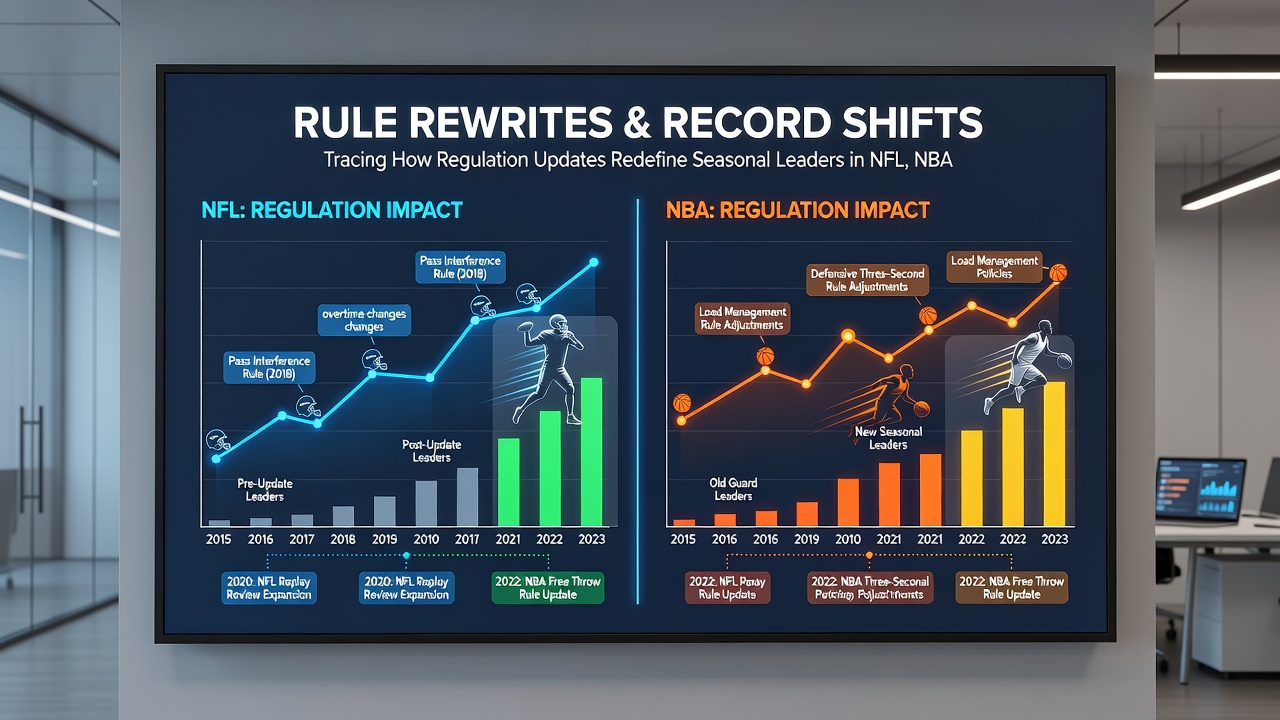
The NFL has introduced multiple rule modifications targeting player safety and game flow since 2015, including stricter enforcement on helmet-to-helmet contact and the legalization of certain low blocks in 2021. These updates coincided with increases in average passing yards per game, as defensive schemes adapted to avoid penalties that previously limited aggressive coverage. League records indicate quarterbacks in the top statistical tier posted higher completion percentages after the 2019 pass interference review rule took effect, because officials gained authority to overturn missed calls on deep throws. Running back leaders meanwhile experienced slower accumulation rates in some seasons when teams shifted toward pass-heavy strategies to exploit new protections for receivers.
NBA Rule Refinements and Scoring Distributions
Changes to defensive three-second violations and freedom of movement guidelines in the NBA have contributed to elevated three-point attempt volumes among perimeter players. Tracking data released by the league demonstrates that teams averaged more three-pointers per game following the 2019 emphasis on calling fouls on off-ball contact, which reduced physical defensive schemes and opened spacing for shooters. Seasonal assist leaders often emerge from point guards who operate in systems that capitalize on these spacing rules, while interior scorers see their rebounding and shot-blocking opportunities fluctuate when foul trouble rules accelerate rotations. Analysts following the 2026 campaign observe continued emphasis on transition play that rewards players who adapt quickest to the revised foul criteria.
MLB Modifications and Batting Average Impacts
The MLB's 2023 ban on infield shifts and addition of the pitch clock produced immediate effects on batting averages and home run totals. Official statistics compiled after the first full season under the new rules revealed a rise in batting averages for left-handed hitters who previously faced overloaded defenses, with several players crossing the .300 threshold who had hovered below it in prior years. Pitchers adapted by increasing velocity on certain offerings to beat the clock, which in turn altered strikeout rates among power hitters. Data released through MLB sources shows stolen base leaders benefited from the larger bases and pickoff restrictions, creating new pathways for speed-oriented players to top seasonal charts in categories that had stagnated for a decade.
Soccer Law Changes and Goal-Scoring Patterns
FIFA and UEFA updates to offside interpretation and substitution protocols have influenced scoring distributions across domestic and international competitions. The 2022 clarification allowing attacking players to keep body parts level with defenders expanded marginal offside calls, leading to slight increases in goals from set pieces according to competition reports. Additional substitutions permitted during extra time in knockout tournaments further altered fatigue-related metrics, allowing teams to maintain pressing intensity that generates more shot opportunities for forwards. Seasonal goal leaders in top European leagues reflect these dynamics, with data indicating higher tallies for players positioned in wide areas where new interpretation guidelines create clearer pathways to the net.
Cross-League Patterns Emerging in 2026
November 2026 standings across the four leagues demonstrate that players who adjust quickly to revised enforcement priorities continue to dominate updated leaderboards. Research compiled by academic sports performance groups highlights how wearable sensor data now informs rule-making committees, creating feedback loops that accelerate future modifications. Teams that study historical shifts in efficiency metrics gain advantages when regulations target specific actions such as defensive positioning or clock management. The cumulative record books therefore contain distinct eras defined by the dates when particular rules took effect rather than gradual evolution alone.
Conclusion
Rule revisions function as structural interventions that redistribute statistical opportunities among positions and player archetypes. League archives and performance databases confirm that seasonal leaders in passing, scoring, hitting, and goal tallies frequently change when enforcement priorities shift, and the 2026 season continues to illustrate these connections. Organizations responsible for rule oversight draw on aggregated play-by-play information to evaluate intended and unintended consequences before codifying further adjustments.